By Way of Introduction
Call me Ishma Hey there.
My name’s Noah LaBelle.
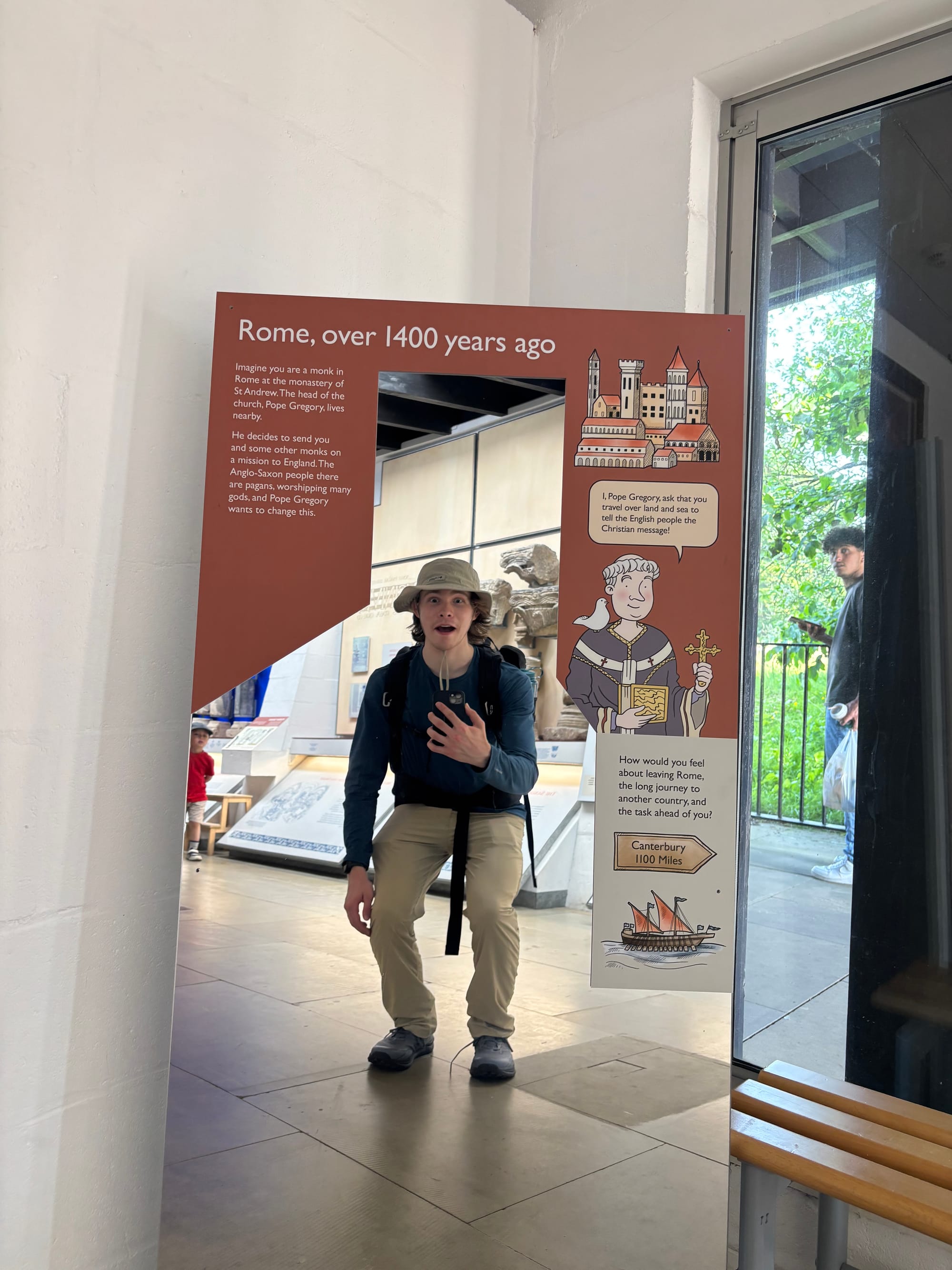
This is me, circa May 2026:
What’s your name?
(garbled mélange of syllables across space and time)
It’s great to meet you, GMOSASAT! Come and stay a while.
Oh, why, you ask? You’ve got things to be, places to do?
This summer, so do I.
To do:
- Canterbury, England
- Rome (’nuff said)
- Some six-hundred municipalities betwixt, spanning the UK, France, Switzerland, Italy, and the Vatican
To be:
- A pilgrim, walking on foot from locale to locale
- A writer/reporter/conversationalist/wannabe-multi-hyphenate
Done with the pith, are you? (This is why I usually write in Google Docs and not on this new-fangled site I’m setting up from the path.) Here proceedeth prose closer in style to what you’ll read in these pages pixels:
By Way of Introduction, Take Deux
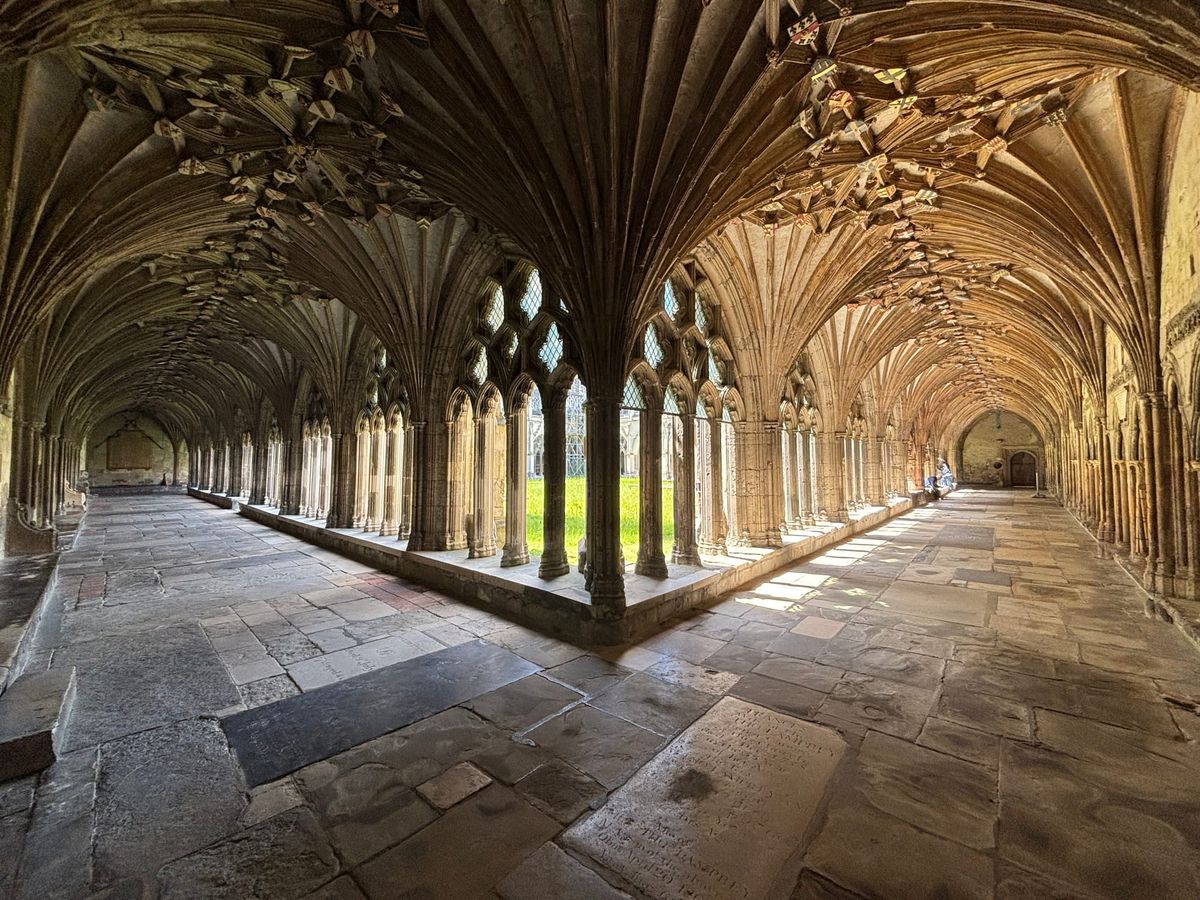
All roads lead to Rome, they say. One such road begins in Canterbury, England, the spiritual center of the Anglican Communion. The Via Francigena follows the 2,000-kilometer path that Sigeric, Archbishop of Canterbury, took in 990 AD to pick up some fresh vestments from the Pope. (This was pre-Reformation.) His journey meandered past Dover’s White Cliffs, over the Channel, through the French countryside and cathedral cities. Sigeric then crossed the Swiss Alps before coasting down the Aosta Valley, fording the Po, and traversing alongside Tuscany’s cypresses and vineyards en route to the Holy See.
I hope to follow Sigeric’s route along the seventy-nine stages his personal clerk so dutifully noted during their return journey to the Isles. I also intend to write of my travels. But rather than focusing on the path—Sigeric’s journal ventured little beyond itinerary—my writing will center on the people I encounter.
The way of course will be made by walking—and talking, letting the living stories of this ancient road unfold.
Now, why a 1,200 mile schlep, and why now? For one, I’ve gained a much more personal stake in the peregrinations of prelates recently. Two years ago my father was elected Bishop of the Episcopal Diocese of Olympia. With my family, I have twice walked the Camino de Santiago—from the Pyrenees and from Porto. Between the two, I’ve logged about 650 miles, enough to teach me the cadence of daily walking. Pilgrimage is a medium particularly well suited for connection with others. How else to spend the walk but by talking? How else to escape the summer swelter but by arriving early, exploring the next town and its denizens?
There’s also my sense that Christianity’s trajectory, though inflecting, doesn’t yet feel calcified. In October, under the watchful eye of some nude folk—seraphs, saints, and sinners alike—Pope Leo XIV and King Charles III prayed together in the Sistine Chapel. This was no ordinary grace. It had been nearly five centuries since Michelangelo dolloped the famed fresco above them and since Henry VIII broke with the Roman Catholic Church to annul his first marriage, an act which created the Church of England. In linking the proverbial Sees of Anglicanism and Catholicism, the Via Francigena has much to reveal about this newly emerging relationship.
Nor is any pilgrimage separate from the person walking it. Since coming to Princeton—and after nine months living with a Muslim homestay family in Dakar, Senegal—I’ve found deep community in the Episcopal chaplaincy. As I continue to reground my faith on my own terms, I surmise the Via Francigena has much to teach me about my own creed.
My objectives, stated concretely: to walk from Canterbury to Rome along Sigeric’s route over 80 to 90 days. To build relationships, report, and write a series of dispatches. Whether these installments will lead to a longer-form narrative I am unsure. What I do know is that those I find in Alpine monasteries, sun-scorched trails, makeshift migrant camps in Calais, or other unknown places will surprise me—and, hopefully, those who read along.
Questions I suspect might become frequently asked (but, of course, I’m stabbing in the dark here):
Ok, that’s cute and all, but who are you, actually?
I’ve just wrapped up my second year as an undergraduate at Princeton University. When not on pilgrimage or in New Jersey—noted for being one of the states in the Union—I’m based out of Seattle, Washington. I live there with my mother, my father, my sister (when we’re both home from uni), and our beloved American Brown Dog, Charlie Brown. I grew up in Southborough, Massachusetts, abutting Hopkington, which is 26.2 miles from Boston.
Not where and whose; who?
Guilty as charged. Though the focus of the walk is learning from others, that’s a question the Archbishop of Canterbury herself recently tossed my way as one I’ll have to answer for people. (Post to come.) Keep reading and maybe we’ll both find out.
Don’t you have some gratitude to profess?
You’re right, I do. I wouldn’t be writing and walking this summer without the generous financial support of the Martin A. Dale ’53 Summer Award for sophomores. Princeton and its folks’ munificence have enabled some truly ineffable opportunities to see and be in the world, this among them, for which I lack the words to give exhaustive thanks and of which I’m not sure I’m deserving. But I’m not a fan of the whole “lacking words” thing. (Spit it out!) To the powers that be: Thank you for your vote of confidence in this project, its contributions to my development, and me. (And let’s just shove that insecurity back into a Sea To Summit® stuff sack with the rest of the fears, manifest in gear, I carry in my backpack.)
Is this only about religion?
Couldn’t be further from the case. (I hope.) Everyone is devoted to something and/or someone. Everyone has made sacrifices. This, in essence, is pilgrimage. This, in essence, is life. (And even Pope Leo’s got a secular Side.)
Why not Substack?
Any platform that integrates infinite scroll algorithmically attuned to your dopamine antennae ought to be exorcised along with th—oh, sorry. That guy comes out when he’s not reading on paper enough. It’s okay, buddy. There aren’t (m)any monsters under the screens…
AI?
Heck no. Never for constructing these sentences, at least. But as I try to churn these entries out after long walking days and forget (or don’t know) how or why or when or where or that some historical happenstance took place and who was involved, I may privilege an LLM over Command+F on Wikipedia if a good olde-fashioned Google search ain’t cutting it.
What’s the best piece of advice you’ve ever received?
Say these four statements often: I don’t know. I need help. I’m sorry. I was wrong. And mean them. (I know I’m gonna need them on this walk, and on this site. Thanks for bearing with me.)
Can I read more of your writing?
Ok, nobody asked this [at least not after reading these QISMBFA(BOCISITDH)s]. I’m most proud of this one—which I also believe to be exigent—written alongside brilliant, tenacious peers and colleagues. These guys, of varying polish, panache, and import, are also from last summer. More TK, as always.